Emergency Tree Services In Toronto
Fast Tree Removal When You Need It Most
Proudly Serving Toronto, Etobicoke, Mississauga, Scarborough, Oakville, Vaughan, Richmond Hill, Markham
When a Tree Falls in Toronto, the Next Few Hours Matter Most
What to Do - and What to Avoid - Before Help Arrives
You wake up after a night of heavy rain and wind, walk to your back window, and find a large limb sitting across your fence – or worse, resting against your roof. It’s disorienting. If you’ve ever needed emergency tree services, you already know that the first hour is mostly about figuring out who to call, not panicking.
First thing: figure out whose tree it is. If the fallen tree or limb is on City-owned property, the road allowance, or a public boulevard, you call 311 Toronto. They’ll log it and dispatch the right crew. But if the tree is on your private property – or if a neighbour’s tree has come down onto your yard – that’s a private matter, and 311 won’t send anyone out. That’s when you need a private arborist for fallen tree removal.
If the tree is near power lines, don’t touch it. Don’t let anyone near it. Toronto Hydro clears lines, and they need to be involved before any property-damage tree work begins. A downed or leaning tree contacting a line is still energized until Hydro confirms otherwise. Your job is to stay back and make sure others do too.
Beyond the power line situation, most storm scenarios are serious but manageable. A leaning tree against a structure isn’t always about to collapse. Getting an ISA Certified Arborist on site to do a quick hazard assessment tells you exactly what you’re dealing with – and what can wait versus what needs to move fast.
Emergency storm cleanup after a major Toronto storm is straightforward when the right crew coordinates with the right people from the start.
Need Emergency Tree Services Today?
Toronto's Tree Bylaws Don't Stop Applying During a Storm
How the City of Toronto's Private Tree By-law Affects Emergency Removals
Chapter 813 of the City of Toronto Municipal Code – the Private Tree By-law – governs the removal of trees on private property. A storm doesn’t create an automatic exemption. If a tree on your property meets the bylaw’s size threshold (generally 30 cm in diameter measured at 1.4 metres above grade), removing it without a removal permit could expose you to a fine, even if the tree is already down.
The bylaw includes genuine exemptions. If a tree poses an immediate threat to life or safety, emergency removal may be permitted without a permit obtained in advance. But “immediate threat” has a specific meaning under the bylaw, and documenting it correctly matters. This is where having an ISA Certified Arborist on site from the start is useful – not just for the work itself, but for the paperwork that follows.
If you’re near the Humber River corridor, your trees may face additional scrutiny. Properties in that area often contain mature trees with extensive root systems, and removal decisions can attract closer attention from the city. An Arborist Report prepared by a qualified professional can support your case and keep you on the right side of Toronto’s Tree Removal By-laws.
The permit process doesn’t have to slow down an emergency response. Knowing which situations require a Tree Removal Permit and which don’t – and having the documentation ready either way – is part of responsible urban tree care. With over 18 years of working across Toronto, the team at White Glove knows how to move quickly without putting you in a difficult position with the city afterward.
An ISA Certified Arborist Does More Than Remove the Tree
ISA Certified Arborist status is more than a title. It’s a formal qualification that requires passing a comprehensive exam covering tree biology, structural assessment, soil science, and risk evaluation. In practical terms, it means the person assessing your tree knows how to read it – not just cut it.
When a certified arborist arrives on site, the first step is a proper on-site hazard assessment. That means looking beyond the obvious damage. A tree that’s partially fallen may have a compromised root plate, where the root system has partially lifted from the ground, and the tree is no longer structurally anchored. A tree that looks stable nearby might have a co-dominant stem – two main trunks growing from a shared union – that’s under significant tension and could split without warning. An untrained crew won’t check for these details.
If you’ve had a large limb come down, there’s a reasonable chance other dead or hanging material is still in the canopy. Those are called widow maker limbs, and they’re one of the most common causes of injury during storm cleanup. Identifying them before chainsaw work begins is part of a tree risk assessment.
For your insurance claim, documentation matters. An arborist report prepared by an ISA Certified Arborist gives your insurer a credible, professional account of the damage and the work performed. That kind of report carries weight in ways that a basic invoice simply doesn’t.
Every emergency call gets an ISA Certified Arborist on site. That’s not the industry standard in Toronto, but it’s the standard here.
A Tree That Looks Stable After a Storm Is Not Always Safe
The Structural Warning Signs That Are Easy to Miss Without a Trained Eye
Most people walk outside after a storm, see their trees still standing, and figure everything is fine. That assumption is understandable – but it misses what’s actually happening inside the tree.
Storm-stressed trees can suffer serious structural damage that isn’t visible from the ground. A co-dominant stem – where two main trunks grow upward from the same fork – can develop a deep internal crack during high winds without splitting apart. The tree looks whole. It isn’t. That’s a tree structural defect that only gets worse over time, not better.
Root plate failure is another condition worth knowing about. If the ground around the base of a tree feels soft, or if you notice a slight lift in the soil on one side, the root system may have shifted during the storm. A leaning tree that wasn’t leaning before a weather event is not something to watch and wait on.
Widow maker limbs are exactly what they sound like – dead or partially attached branches suspended in the canopy that didn’t fall during the storm but are no longer structurally connected. Toronto’s mature tree canopy, particularly in neighbourhoods near the Humber River corridor, includes trees large enough that a single dropped limb can cause serious property damage.
If you had storm damaged trees assessed after the last major weather event, you likely already know this. If you didn’t, a Tree Risk Assessment is the most straightforward way to find out what you’re actually dealing with. Identifying a dangerous tree hazard early helps prevent storm damage from turning into a hazardous tree removal situation under worse conditions.
Dead tree removal and structural support through tree cabling and bracing are both options depending on what an assessment finds – but none of that is possible without first knowing what the tree’s condition actually is.
Tree Removal
Safe efficient removals
Precision Pruning
Improve structure, safety, and tree health
Tree Trimming
For beautiful, healthy trees
Emergency Tree Services
Emergency tree services to keep you safe
Stump Grinding
Stump grinding for a usable landscape
Deep Root Fertilization
Fertilization for long-term tree health
Plant Health Care
Plant health care for strong, resilient trees
Arborist Consultation
Professional tree health evaluations
Tree Protection Zoning
Tree Protection Before You Break Ground
What Happens When White Glove Arrives at a Toronto Emergency
From First Assessment to Clean Property: How the Job Actually Gets Done
When the crew arrives, the first thing they do is an on-site hazard assessment. Before anyone touches a chainsaw, the arborist walks the property, checks the damaged tree’s lean and load, looks for split unions, and confirms whether any part of the tree contacts a structure or utility line. If there’s a Toronto Hydro concern, we flag it immediately so the right coordination happens before any cutting begins.
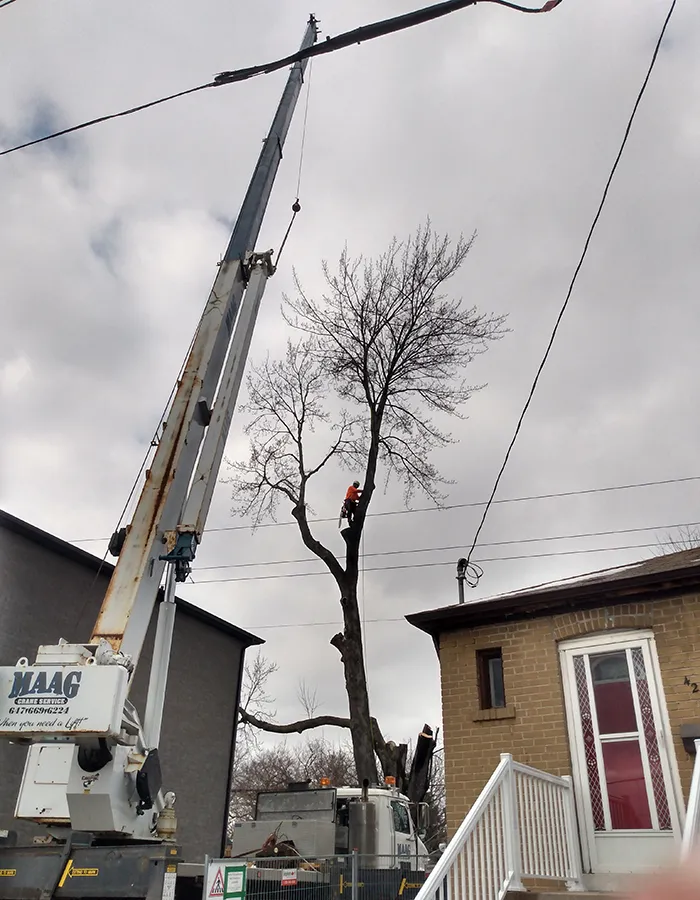
From there, the removal plan takes shape based on what’s actually in front of us. Tight urban lots, fences, parked vehicles, proximity to your house – all of it factors in. Sectional Tree Dismantling is the standard approach when a straight felling isn’t safe. The tree comes down in controlled sections from the top, piece by piece, until the risk is gone. If the situation calls for it, Crane Tree Removal is an option too.
Once the tree is down, Stump Grinding and full Tree Debris Cleanup are part of the same visit. You won’t be left with a half-finished yard. If you’re filing an Insurance Claim for Tree Damage, we can provide the documentation your insurer will likely ask for.
The same visit can also include a Tree Health Assessment of nearby trees. After a major storm, surrounding trees can carry hidden stress fractures or show early signs of Emerald Ash Borer damage that’s worth catching now rather than later.
Because the crew carries full WSIB Coverage and liability insurance, any work done on your property doesn’t put you at risk. Our 24/7 Emergency Tree Service and 24 Hour Emergency Response mean you don’t have to wait until the next business day to get a trained set of eyes on the problem. If a tree is down now, reach out.
ISA-Certified Arborists